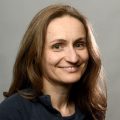
MERIDEN — Though Deborah Glazer spends most of her work time caring for patients as a primary care physician, she does some shifts tending to patients’ more urgent needs in Alice Peck Day Memorial Hospital’s emergency department.
When she does, she hears long-time APD emergency department doctor Douglas Cedeno’s voice in her head.
“Other (clinicians) tell me that” too, she said. “I feel like he’s still caring for patients through us.”
Because ER physicians treat patients they may not have seen before, they have to be more comprehensive in their evaluations than primary care doctors who more often get to know their patients over time, Glazer said.
“Seeing sicker people makes you a better doctor,” Glazer said. “I learned that from him.”
Cedeno, who died of pancreatic cancer in June at the age of 69, was one of the founders of APD’s emergency department, which when it opened in the late 1980s billed itself as the Immediate Care Center, there “for life’s little emergencies.”
He served as director of the service for about 25 years and continued to practice there until last year, even after APD contracted with the Texas-based EmCare to staff the department. Colleagues remember him as a kind and thoughtful practitioner who enjoyed learning and teaching throughout his career. His family and friends say the love of learning and teaching was something that extended into his personal life and his enjoyment of a variety of recreational activities, including biking, skiing, kayaking and martial arts.
“He cared about people,” said Dr. Chris Mazur, one of Cedeno’s first recruits to APD’s emergency department.
He said Cedeno served as a professional mentor and also as a friend for three decades. Cedeno’s skill in caring for patients included keeping a close eye on new technologies as they became available, but also and perhaps more importantly in maintaining a kind bedside manner and good rapport with his patients.
When patients walked into APD’s emergency department — which began in a hallway, moved to a trailer and eventually earned its own space in the hospital — “you basically meant as much to him as his family did for the time he was taking care of you,” his son Jeff said.
Though his Meriden cabin in the woods was a far cry from the New York City borough of Queens where Cedeno grew up, he carried with him a sense of the importance of serving the community. That sense was something he absorbed from his Puerto Rican parents, Adrian and Blanca.
Blanca Cedeno, who died in 2015, had a long career in the New York City Housing Authority, working her way up to become a member of the board of the authority, according to her obituary. Blanca also served as chair of the board of trustees at Boricua College, the first university in New York for Puerto Rican students, and helped found two organizations aimed at creating educational and leadership opportunities for Puerto Rican youth. Adrian Cedeno recently celebrated his 100th birthday and now lives in Florida.
Rather than focus on one segment of the community, Cedeno focused his career on caring for people of all backgrounds who happened to walk through the door of APD’s emergency department, need assistance while he was serving on the ski patrol at Whaleback or simply be a friend, neighbor or relative in need of care, Jeff Cedeno said.
“He was an amazing physician,” Glazer said.
Cedeno provided “excellent patient care with an emphasis on caring,” she added.
For example, when Cedeno’s Meriden neighbor John Woodward-Poor was sick, Cedeno stopped by the Woodward-Poor house on his way home from a shift at the hospital. He took a look at Woodward-Poor, whose kidneys were beginning to fail, and told him to go to the hospital, Woodward-Poor’s widow Jeanne said.
“I put too much time into this family to lose the big kahuna now,” Jeanne recalled Cedeno saying.
Cedeno then went home to change and followed the Woodward-Poors back to the hospital, helped to diagnose John and send him on to specialists at Dartmouth-Hitchcock. Throughout Woodward-Poor’s illness — multiple myeloma, a cancer formed in the blood cells of bone marrow that quickly turned into deadly plasmablastic myeloma — Jeanne said Cedeno helped to counsel her as she navigated the medical system.
Before that intervention, which Jeanne credits with giving Woodward-Poor an additional 11 months at the end of his life, Cedeno had already been the first on-scene when one of the Woodward-Poor children, Ian, then 3, fell into a frozen lake. (He fully recovered.) Cedeno was also on shift when another son Cedric, then 10, came into the emergency department with two smashed jaws from a skiing accident.
“Doug was always there,” Jeanne Woodward-Poor said. “He was a really good doctor. He knew what he was doing.”
After growing up in Queens, Cedeno earned his undergraduate degree at Marist College in Poughkeepsie, N.Y. He then attended Mount Sinai School of Medicine — now the Icahn School of Medicine at Mount Sinai — where he earned his medical degree and met his wife Adrienne, a fellow New Yorker who was studying to become a nurse at the nearby City College of New York. At the time, the medical students and nursing students would play volleyball together, Adrienne said.
“One thing led to another,” she said. “…We were married 46 years.”
Their move to New Hampshire was prompted by Cedeno viewing a flyer advertising a fellowship at Mary Hitchcock Memorial Hospital, then in Hanover. He made the first trip up alone and got off the train to find snow on the ground. He found romance in the “beauty of Hanover and the area in the winter,” Jeff said.
So he took the fellowship and returned to New York to inform his then-pregnant wife that they would be moving to the Upper Valley, which they then did with a 9-day-old baby Dorienne, Jeff’s older sister. It took some adjusting, but the family eventually fell into country living. Adrienne took up gardening with a passion and Cedeno delighted in the outdoor recreation opportunities the region has to offer: biking, kayaking, hiking and skiing.
“I used to laugh at him,” Adrienne said. “He had one butt (and) four bicycles.”
Glazer and her husband, Tim Gilbert, were often Cedeno’s companions on his outdoor adventures. On one memorable bike trip, the group embarked from Silver Lake in Barnard, Vt., on what was supposed to be a two-hour ride, leaving Cedeno’s then-teenage daughter behind to enjoy the lake. Some wrong turns later, the two-hour trip became a six-hour one.
When they finally found a man to help them find their way, he told them, “You’ve got the wrong map,” Glazer recalled.
In part to balance out the sometimes-chaotic work of being an emergency room physician, Cedeno found peace through meditative martial arts of tai chi and karate.
“I think it calmed him,” Adrienne said. “Getting your energy moving in more peaceful, more appropriate ways. That really resonated with him.”
Cedeno taught tai chi and karate, applying a similar dedication to them that he applied to other areas of his life. If someone in a class he was teaching was struggling, he would “help them bring everything up to speed,” Suzie Whidden, a fellow martial arts practitioner, said.
“He was just a good guy,” Whidden said.
Because he saw the importance of a life outside of work, Mazur said Cedeno worked to create a fair schedule for those who worked with him at APD.
He “didn’t want to overburden people with work,” Mazur said.
While people in medicine can sometimes get caught up in a competition for who has the worst schedule, Mazur said Cedeno “did not buy into that.”
That ability to balance work and personal time was something that his children remember from their youth.
“If I had a soccer game as a kid, my dad was there,” Jeff Cedeno said. “…It wasn’t that he was kind of that modern stereotype helicopter parent. He was just there.”
Cedeno also was a phone call away anytime a family member had a medical question. Dorienne credits him with resetting both her children’s nursemaid elbows, a dislocation common in small children.
And, though neither of his children went into medicine, his granddaughter Sophia, now 9, became interested in the field after Cedeno diagnosed her appendicitis over the phone.
Dorienne, who is a high school English teacher living in Waterbury, Vt., said her father’s loss is something the family feels both for personal and for medical reasons.
Her husband Dan told her, “I don’t know who I’m going to call now because your dad’s the only doctor I trust.”
The last couple of years of Cedeno’s life were difficult. He suffered a spinal injury two years ago, which required treatment at Beth Israel Deaconess Medical Center in Boston. Then, last August shortly after his retirement from APD, his sister Arleen died unexpectedly. After he returned from caring for her and her affairs, he didn’t feel well and eventually, with the help of a friend’s ultrasound machine, diagnosed himself with pancreatic cancer. It was stage IV at the time of the diagnosis.
Though he pursued what treatment options there were, they were not successful. “It was a tough diagnosis,” Jeff said.
Despite Cedeno’s failing health, he took one final family trip and he got to see Jeff’s wife’s native Poland and sip a cappuccino in the sun on Italy’s Amalfi Coast.
If there was “one thing that man loved, it was his coffee,” Jeff Cedeno said.
Cedeno also treasured both his profession and the role Alice Peck Day played as a community hospital in the Upper Valley.
In one of his last conversations with Dorienne, he told her, “I loved practicing medicine and I think I was really good at it.”
A memorial service for Cedeno is planned for July 27 from 12 – 2 p.m. at the Plainfield Town Hall. He wanted the event to be a celebration, so Adrienne asks that attendees dress accordingly.
Valley News Staff Writer Nora Doyle-Burr can be reached at ndoyleburr@vnews.com or 603-727-3213.